
A lot of businesses do not ignore CRM. They simply never fully commit to it.
You may already have a CRM in place. You might be collecting leads, updating deals, or sending occasional emails. But deep down, it is not really driving your growth. Leads go quiet. Follow ups are inconsistent. Your marketing feels more reactive than intentional.
This is what happens when a business has a CRM but has not decided to take CRM seriously.
That decision is where the real shift begins.
When CRM is used with intention, it stops being a place where data sits and starts becoming a system that guides your sales and marketing. You gain clarity on where every lead stands. Your follow ups become consistent. Your communication becomes more relevant and timely.
Instead of guessing what is working, you start seeing it clearly.
In this article, you will learn what actually changes when you make that shift and how it can transform the way your business attracts, converts, and retains customers.
Taking CRM seriously is not about installing new software or adding more tools. It is about building a system that supports how your business attracts, manages, and converts customers.
It requires structure, consistency, and a clear strategy that connects your sales and marketing efforts.
In practice, this shift becomes clear in how your systems, data, and workflows are structured and used.
It’s About Systems Not Tools
Many businesses assume CRM success comes from choosing the right platform. In reality, it comes from how well your processes are defined and followed.
CRM is not just software. It is a system that aligns your sales and marketing teams, ensuring that leads are handled consistently from first contact to conversion.
Clean, Structured Data Becomes a Priority
When CRM is taken seriously, data is no longer messy or inconsistent. Every contact is stored in a structured way, with standardized fields and clearly defined pipeline stages.
This makes it easier to track progress, understand your customers, and maintain clarity across your team.
Automation Replaces Manual Work
Manual tasks start to disappear once the right systems are in place. Lead assignment, follow ups, and email marketing automation become consistent and reliable.
For example, a new lead can automatically receive a welcome email followed by a nurture sequence, without anyone needing to manually send each message.
Decisions Become Data-Driven
Instead of relying on guesswork, decisions are based on clear data. Dashboards and reports provide visibility into what is working and what needs improvement.
You can track performance, measure results, and make adjustments with confidence.
This is where most businesses realise they need expert guidance.
For many businesses, the problem is not a lack of effort but a lack of structure. Teams are busy managing leads, sending emails, and closing deals, yet results remain inconsistent. Without a clear CRM strategy, important details get lost and growth becomes difficult to sustain.
Here are some of the most common signs that your CRM is not being used effectively:
1. Scattered Customer Data
One of the clearest signs of a weak system is scattered customer data. Information lives across spreadsheets, inboxes, and WhatsApp, with no single source of truth or clear visibility across your team.
Without CRM automation, there is no reliable way to capture, organise, and update this data in real time.
As a result, important details get missed and follow ups become inconsistent. For example, a lead fills out a form, but the message gets buried in an email and no one follows up.
2. Inconsistent Sales Follow-Ups
Another common issue is inconsistent sales follow ups. Leads come in, but without a clear system, many of them slip through the cracks. There are no reminders, no structured process, and no automation to ensure timely responses.
This has a direct impact on conversions. Studies show that businesses that respond to leads within 5 minutes are up to 21 times more likely to qualify them compared to those that wait longer.
Without a reliable follow up system in place, it becomes easy to lose potential customers simply because no one reached out at the right time.
3. Marketing That Feels Like Guesswork
This is where things start to feel frustrating.
You are sending emails. Campaigns are going out. But the results are inconsistent, and it is hard to tell why.
No clear segmentation
No real personalisation
The same message going to everyone
So engagement stays low, and every campaign feels like a shot in the dark.
For example, sending one generic newsletter to your entire list will almost always underperform compared to a targeted campaign that speaks to a specific group based on their behavior or interests.
Without a structured approach, marketing becomes less about strategy and more about hoping something works.
4.No Clear Customer Journey
Everything looks active on the surface, but there is no clear direction behind it.
Leads move from one stage to another without a defined process, and it is hard to see what is happening inside your pipeline at any given time. Without clear lifecycle stages, decisions become reactive instead of intentional.
You are working, but not always moving deals forward in a consistent way.
Once the right systems are in place, the difference becomes clear. Things stop feeling reactive and start becoming structured, measurable, and easier to manage.
This is what effective CRM implementation is meant to achieve.
1. You Stop Losing Leads
Before this point, losing leads often feels normal.
Messages get missed. Follow ups are delayed. Opportunities disappear quietly.
But once a proper system is in place, every lead is captured and tracked automatically. Follow ups happen on time, without relying on memory.
Studies show that up to79% of leads are never converted due to poor follow up. Fixing this alone can significantly impact your revenue.
2. Your Sales Process Becomes Predictable
Instead of wondering what is happening in your pipeline, you can see it clearly.
Deals move through defined stages. You know what needs attention and what actions come next. Over time, this makes your sales process more stable and easier to forecast.
3. Your Marketing Becomes Targeted and Effective with Email Marketing Automation
Marketing becomes more intentional and relevant.
Instead of sending the same message to everyone, you can segment your audience and send behavior based emails that match where each customer is in their journey.
For example, new leads can receive on-boarding emails, while existing customers receive offers or retention focused campaigns.
4. Customer Experience Improves Dramatically
Communication becomes more timely and personalised.
Customers receive the right message at the right time, which builds trust and makes interactions feel more relevant and professional.
5. Your Team Works Smarter, Not Harder
Your team spends less time on manual tasks and more time on meaningful work.
With clear responsibilities and automated processes, everyone knows what to do and when to do it, without constantly checking or following up manually.
Let’s take a simple example.
A small service-based business was generating leads consistently through their website and social media. On paper, everything looked fine. But internally, things were messy.
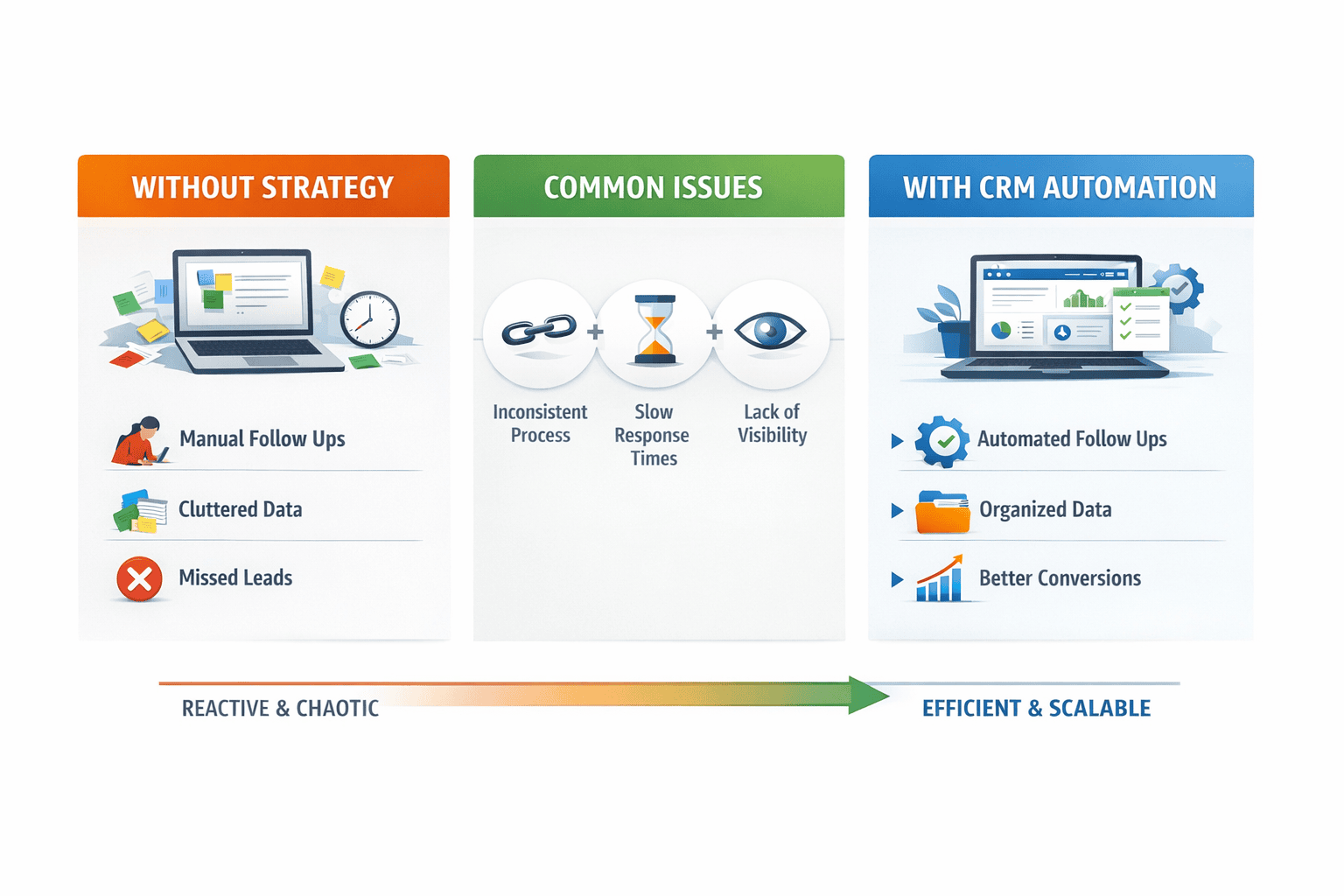
Before CRM Optimisation
Leads were coming in, but there was no structured way to manage them.
Some inquiries sat in email inboxes. Others were noted in spreadsheets. A few were followed up through WhatsApp. There was no central system, so it was impossible to see who had been contacted and who had not.
Follow ups depended entirely on memory. If someone forgot, the lead was gone.
Email marketing was just as inconsistent. A generic newsletter was sent occasionally, but there was no segmentation, no targeting, and very little engagement.
The business was putting in effort, but results were unpredictable.
After CRM Implementation
Once they decided to take CRM seriously, the first change was structure.
All leads were captured into one system automatically. Each lead moved through a clearly defined pipeline, so the team could see exactly where things stood at any time.
Follow ups were no longer manual. Automated sequences ensured that every lead received a timely response without relying on memory.
Email marketing also changed. Instead of sending one message to everyone, contacts were segmented. New leads received onboarding emails, while existing customers received more relevant and timely campaigns.
Everything started to feel more controlled and intentional.
Results
Within a few months, the difference was clear.
Response times improved significantly, which led to more conversations and higher conversions. Email engagement increased because messages were more relevant.
At the same time, the team spent less time chasing leads and more time closing them.
What changed was not just the tools, but the way the business operated day to day.
Trying to fix your CRM is a smart move, but this is also where many businesses create new problems without realizing it.
Instead of simplifying their processes, they add complexity, skip key foundations, or fail to get their team aligned. This is especially common when setting up CRM for small business, where every decision has a direct impact on time, resources, and results.
Here are some of the most common ways businesses unintentionally hold their CRM back:
1. Overcomplicating The System
One of the fastest ways to break a CRM is by making it too complex too early.
Businesses try to build the “perfect” system by adding too many fields, creating detailed workflows, and connecting multiple tools at once. On paper, it looks powerful. In reality, it becomes difficult to use.
The team starts skipping steps, avoiding updates, or using shortcuts. Over time, the CRM stops reflecting what is actually happening in the business.
A good system should feel simple to use, even if it is powerful behind the scenes.
2. Ignoring Data Hygiene
A CRM is only as reliable as the data inside it.
When data is messy, everything else suffers:
Duplicate contacts
Missing information
Outdated records
This leads to broken automation, inaccurate reports, and poor decisions.
Clean data is not optional. It is the foundation of a system that actually works.
3. No Clear Strategy Before Implementation
Another common mistake is jumping straight into tools without defining how the system should work.
Businesses set up pipelines, automation, and campaigns without first mapping out their customer journey. There is no clarity on how leads should move, when follow ups should happen, or what each stage actually means.
The result is a CRM that exists, but does not support real business processes.
The tool is not the problem. The missing strategy is.
4. Lack of Team Adoption
Imagine this.
You invest in a CRM, set everything up, and expect things to improve. But your sales team still manages leads in their inbox. Notes are scattered. Updates are inconsistent.
Now your CRM is no longer a system. It is just another unused tool.
Adoption is what turns a CRM into something valuable.
Taking your CRM seriously does not require a complete overhaul overnight.
What it does require is a clear starting point and a simple plan you can follow. When you approach it step by step, each improvement builds on the last, making the entire system more effective over time.
The process becomes much simpler when you break it down into a few practical steps.
Step 1: Audit Your Current CRM Setup
Start by understanding what you already have.
Before adding anything new, take a close look at your current setup and identify what is actually working and what is not.
Quick audit checklist:
Where are your leads currently coming from
Where is customer data stored
Are follow ups consistent or random
Is your pipeline clearly defined
What parts of your CRM are not being used
This step gives you clarity before making changes.
Step 2: Define Your Customer Journey
A CRM should reflect how customers move through your business.
Map out the key stages from first contact to long term retention.
Think in simple terms:
Lead
Qualified lead
Customer
Repeat customer
Once this is clear, your pipeline, communication, and automation will have direction.
Step 3: Clean and Structure Your Data
Before automation, you need to fix your data.
If your data is messy, everything built on top of it will be unreliable.
Focus on:
Removing duplicate contacts
Filling in missing key fields
Standardising how information is entered
Organising contacts into clear categories
Clean data makes your CRM usable and trustworthy.
Step 4: Implement Key Automations
This is where your CRM starts saving time.
You do not need to automate everything. Start with the essentials:
Automatic lead capture
Follow up reminders
Basic lead nurturing sequences
For example, a new lead can automatically receive a welcome email followed by a simple nurture sequence, ensuring no one is missed.
Step 5: Track and Optimise
Once your system is running, the next step is improvement.
You need visibility into what is working and what is not.
Track key metrics like:
Lead response time
Conversion rates
Email engagement
Pipeline movement
Use this data to refine your process over time instead of guessing.
This step by step approach makes the process manageable and sets the foundation for a CRM system that actually supports your growth.
At first glance, setting up a CRM can seem manageable. You choose a platform, add your contacts, and start building pipelines.
But as your business grows, things become more complex. You need your CRM to connect with other tools, handle automation correctly, and reflect how your sales and marketing actually work. Small mistakes in setup can quickly lead to broken workflows, missed opportunities, and unreliable data.
What looks simple on the surface often requires a deeper level of planning and experience to get right.
Most of these difficulties come down to a few common issues:
1. The Hidden Complexity of CRM Systems
What seems simple at first quickly becomes more complex.
You are not just managing contacts. You are connecting systems, building workflows, and defining how data moves across your business.
Integrations need to work seamlessly
Automation needs to trigger at the right time
Data needs to stay consistent across tools
Without a clear understanding of how these pieces fit together, things can break or behave unpredictably.
2. The Cost of Getting It Wrong
When a CRM is not set up properly, the impact is not always obvious at first.
Over time, it shows up in lost opportunities, missed follow ups, and inefficient processes.
Leads are not converted
Time is spent fixing issues instead of growing
Decisions are made based on incomplete or inaccurate data
The cost is not just technical. It directly affects revenue and productivity.
3. The Value of Expert Implementation
This is where the right guidance makes a difference.
An experienced approach helps you avoid common mistakes, simplify your system, and focus on what actually drives results.
Faster setup with clear structure
Systems built around your business, not just the tool
Fewer errors and better long term performance
Instead of trial and error, you get a system that works from the start.
Ready to Take CRM Seriously?
At some point, you’ll realise how clear the difference is.
You can keep managing leads manually, fixing issues as they come, and hoping things improve. Or you can decide to take CRM seriously and build a system that actually supports your growth.
Businesses that get this right do not just feel more organised. They see measurable results. Studies show that companies using CRM effectively can increase sales by up to 29% and improve productivity significantly.
What CRMInstructors Can Help You With
This is where having the right partner makes a difference.
Instead of guessing your way through setup and optimization, you get a system built around how your business actually works.
CRM setup and optimization tailored to your workflow
Email marketing automation that runs consistently in the background
CRM audits to identify gaps, inefficiencies, and missed opportunities
Everything is designed to be practical, usable, and aligned with your goals.
What You’ll Get
The outcome is not just a better tool. It is a better way of operating.
You get:
Clear systems your team can actually follow
Better conversions from consistent follow ups and targeting
Scalable processes that grow with your business
No more scattered data, missed leads, or guesswork.
Take the Next Step
If you are ready to stop guessing and start building a system that works, now is the time to act.
Book a CRM Audit
Get a clear breakdown of what is working, what needs fixing, and how to improve your setup.
FAQs
Conclusion
Most CRM issues are not immediately obvious.
They show up gradually through missed follow ups, unclear data, and inconsistent communication that quietly affect how your business performs over time.
When you take CRM seriously, those gaps become easier to identify and fix because your processes are clearly defined and supported by the right structure. With effective CRM automation in place, your team no longer has to rely on manual effort to keep everything moving, and your operations become more consistent and easier to manage.
The real shift is not in the tool itself, but in how your business runs.
With the right system behind it, growth becomes more predictable, and improving performance becomes a continuous process rather than a constant struggle.
If your current setup still feels unclear or inconsistent, it may be time to take a closer look at how your CRM is structured and used.